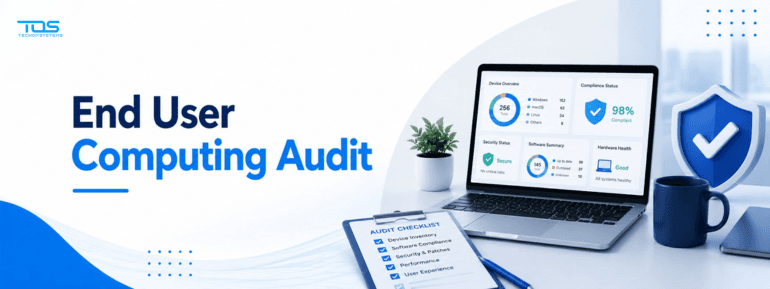
Micro Summary: An IT infrastructure audit reveals hidden risks, compliance gaps, and performance bottlenecks across servers, networks, and cloud systems. This guide explains why enterprise leaders treat infrastructure assessments as a strategic investment, not a technical formality, and how a structured audit strengthens security, resilience, and long-term business performance.
Key Insights
Review these takeaways before reading the complete analysis below.
- Unassessed infrastructure hides security gaps that attackers exploit within weeks, not years.
- Regular IT systems audits reduce downtime, licensing waste, and compliance exposure simultaneously.
- Cloud infrastructure assessments catch Microsoft 365 and Azure misconfigurations before they become breaches.
- Executive reporting turns technical findings into prioritised, board-ready investment decisions.
- Lifecycle management and asset visibility prevent costly emergency replacements and outages.
- Business continuity depends on tested backup and disaster recovery, not assumed protection.
- The right audit partner delivers a remediation roadmap, not just a findings list.
Every undiscovered infrastructure gap is a liability waiting for its moment. An IT Infrastructure Audit turns that uncertainty into a controlled, fundable roadmap.
What Is an IT Infrastructure Audit?
An IT infrastructure audit is a structured review of every technology layer supporting your business. It examines servers, networks, cloud platforms, identity systems, and security controls together. Unlike a single-vendor check, it looks at how these layers interact under real operating conditions.

The goal is not a technical inventory alone. A proper infrastructure health check translates findings into business risk, cost impact, and prioritised remediation steps. That distinction separates a genuine IT infrastructure assessment from a superficial systems scan.
|
Did You Know?
Most organisations discover their first serious misconfiguration only after a breach or outage, not before one. A scheduled infrastructure audit finds it months, sometimes years, earlier.
|
Why Businesses Need Regular Infrastructure Assessments
Infrastructure changes constantly. New applications, remote staff, and vendor integrations all add complexity. Without regular review, that complexity quietly becomes risk.
Reactive Management vs. Proactive Auditing
Reactive IT support fixes problems after they disrupt operations. Proactive auditing identifies the same problems while they are still cheap and quiet to fix.
|
Approach
|
Typical Trigger
|
Business Outcome
|
|
Reactive IT management
|
Outage, breach, or audit failure
|
Emergency spend, downtime, reputational damage
|
|
Scheduled infrastructure audit
|
Planned quarterly or annual review
|
Controlled budget, reduced risk, board confidence
|
|
Ad-hoc vendor check
|
Single system or renewal event
|
Partial visibility, blind spots elsewhere
|
Hidden Infrastructure Risks Most Organisations Miss
Some risks are visible immediately. Others hide inside default settings, forgotten accounts, and undocumented network changes. An infrastructure audit is designed to surface exactly these blind spots.
- Legacy servers still processing production traffic without current patches.
- Former employee accounts retaining active access months after departure.
- Shadow IT applications connected to core systems without security review.
- Untested backups that fail silently until a real recovery is needed.
- Firewall rules accumulated over years, never reviewed or retired.
|
Business Insight
Hidden risks rarely cause damage on their own. They combine, and it is the combination that produces the costly incident.
|
The Business Impact of Outdated Systems
Ageing infrastructure does more than slow down staff. It increases security exposure, raises support costs, and limits the business from adopting new tools confidently.
An infrastructure health check quantifies that impact in operational and financial terms. Executives can then compare the cost of inaction against the cost of a structured upgrade.
|
Executive Tip
Ask your IT partner to express audit findings in downtime hours and dollar exposure, not just technical severity ratings. It changes how the board engages with the roadmap.
|
Network and Server Health Reviews
Network and server reviews form the technical core of any IT infrastructure audit. They confirm that core systems perform reliably under current and projected load.
What a Server Audit Covers
- Patch levels, firmware currency, and end-of-support timelines.
- Storage capacity, redundancy, and failover readiness.
- Segmentation between production, guest, and administrative traffic.
A thorough network audit also maps traffic flow and bandwidth use. Bottlenecks discovered here often explain performance complaints staff have raised for months.
Cloud Infrastructure and Microsoft 365 Assessments
Most enterprises now run hybrid infrastructure, blending on-premises systems with cloud platforms. A cloud infrastructure assessment reviews configuration, licensing, and data governance across that mix.
Validate your Microsoft 365 and cloud environment with expert-led assessments.
Microsoft 365 Assessment Priorities
A Microsoft 365 assessment checks tenant configuration, mailbox security, and data loss prevention rules. It also identifies unused licences draining budget without adding value.
- Conditional access and multi-factor authentication coverage across all users.
- SharePoint and OneDrive sharing permissions reviewed against least-privilege principles.
- Retention and compliance policies aligned to your regulatory obligations.
Validating Your Azure Infrastructure
An Azure assessment reviews resource configuration, cost allocation, and security posture inside your subscription. It confirms workloads follow the Microsoft Well-Architected principles your business already pays for.
Azure infrastructure validation also checks identity federation and network security groups. Misconfigured groups are a common, silent cause of lateral movement during an incident.
|
Consultant Recommendation
Pair an Azure assessment with a Microsoft 365 assessment whenever possible. Identity systems usually span both and reviewing them together avoids duplicated recommendations.
|
Identity and Access Management
Identity is the new perimeter for hybrid infrastructure. An IT infrastructure audit examines how accounts are provisioned, reviewed, and retired across every connected system.
- Privileged accounts without multi-factor authentication enabled.
- Shared credentials used across multiple administrators.
- Orphaned accounts from contractors or acquired business units.
Strong identity and access management reduces breach impact even when other controls fail. It remains one of the highest-value findings in any cyber security assessment.
Endpoint Security and Device Management
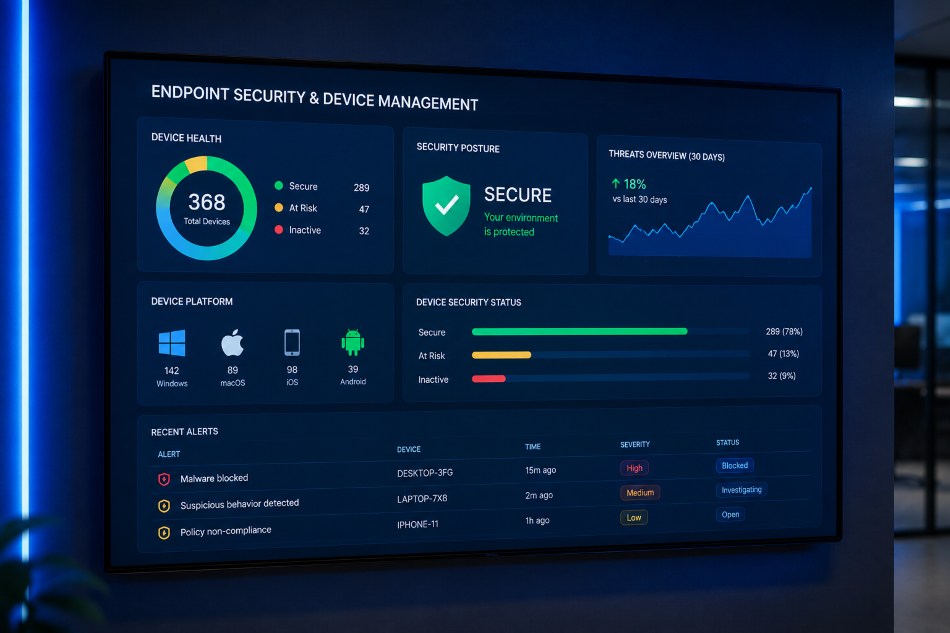
Endpoints remain the most common entry point for attackers. Endpoint management reviews device compliance, patching, and encryption across laptops, mobiles, and remote workstations.
A structured audit confirms every device reporting into your environment meets baseline security standards. Devices that fall outside policy are flagged before they become the incident's origin point.
|
Did You Know?
A single unmanaged laptop connecting to corporate resources can bypass network-level controls entirely, regardless of firewall investment.
|
Backup, Disaster Recovery, and Business Continuity
Backups only matter if they restore successfully under pressure. An audit tests recovery time objectives against documented business continuity requirements, not assumptions.
Business Continuity Checklist
- Confirm backup frequency matches acceptable data loss tolerance.
- Test full system restoration at least twice per year.
- Document recovery roles and escalation paths for key staff.
- Validate offsite or cloud replication for critical workloads.
Disaster recovery planning without regular testing is a false sense of security. The audit converts that assumption into evidence.
Compliance Readiness and IT Governance
Regulators and insurers increasingly expect documented IT governance, not verbal assurance. An IT compliance audit maps current controls against the frameworks relevant to your industry.
Strong IT governance also simplifies future audits. Once controls and documentation exist, each subsequent infrastructure assessment becomes faster and less disruptive to operations.
|
Executive Tip
Treat compliance readiness as a by-product of good infrastructure governance, not a separate project. It reduces duplicated effort and audit fatigue across teams.
|
Lifecycle Management and Asset Visibility
You cannot secure or budget for what you cannot see. Asset visibility gives leadership an accurate, current inventory of hardware, software, and licensing across the business.
Lifecycle management then plans replacement and renewal ahead of failure. This prevents emergency purchasing at premium prices during an outage.
|
Lifecycle Stage
|
Audit Focus
|
Business Risk If Ignored
|
|
Active use
|
Performance and patch compliance
|
Slower staff productivity
|
|
Approaching end-of-life
|
Vendor support timelines
|
Unpatched vulnerabilities
|
|
Past end-of-life
|
Replacement urgency and cost
|
Compliance failure, outage risk
|
Performance Optimisation and Infrastructure Monitoring
Infrastructure optimisation is not only about cutting cost. It ensures systems perform reliably as the business scales, without unplanned capacity constraints.
Ongoing infrastructure monitoring extends audit value between formal review cycles. It catches drift early, before small issues compound into major incidents.
|
Business Insight
Organisations that pair periodic audits with continuous monitoring detect anomalies significantly faster than those relying on annual reviews alone.
|
Documentation, Vendor Risk, and Cloud Governance
Undocumented infrastructure creates dependency on individual staff members. An audit produces current network diagrams, configuration records, and access documentation for the whole environment.
Vendor and Cloud Governance
Vendor risk assessment reviews third-party access and data handling practices. Cloud governance then confirms ownership, accountability, and monitoring for every cloud service in use.
- Vendor contracts reviewed for data protection and support commitments.
- Cloud spends reconciled against actual business usage patterns.
- Shared responsibility boundaries clearly documented for every platform.
Executive Reporting and Audit Deliverables
Findings are only useful when decision-makers can act on them. Executive reporting translates technical detail into prioritised business risk, cost, and timeline.
|
Deliverable
|
Purpose
|
|
Executive summary
|
Board-ready overview of risk and investment priorities
|
|
Risk register
|
Prioritised list of findings with business impact ratings
|
|
Remediation roadmap
|
Sequenced action plan with timelines and ownership
|
|
Technical appendix
|
Detailed evidence for IT and compliance teams
|
Consultant Recommendation: request a remediation roadmap with every audit, not just a findings report. A list of problems without sequencing rarely gets funded or actioned.
Further Reading on IT Audits and Infrastructure Risk
Executive reporting sits at the centre of a valuable audit, but it works best alongside the wider governance picture. The two resources below expand on how audit findings connect to enterprise risk oversight and to the day-to-day reliability of your support model.
Strategic Role of IT Infrastructure Audit Firms in Enterprise Risk Governance examines how audit findings feed into board-level risk registers and long-term governance planning, extending the executive reporting practices covered above.
→ Strategic Role of IT Audit Firms in Enterprise Risk Governance
How IT Support Companies in Melbourne Help Businesses Grow Securely looks at how ongoing support and monitoring sustain the improvements an infrastructure audit identifies, once the remediation roadmap is underway.
→ How IT Support Companies in Melbourne Help Businesses Grow Securely
How to Select the Right IT Audit Partner
The right enterprise IT consulting partner combines technical depth with clear business communication. Look beyond certifications toward how findings are prioritised and explained.

- Proven experience across hybrid infrastructure, not one platform alone.
- Clear executive reporting alongside detailed technical findings.
- A defined remediation roadmap, not just a diagnostic report.
- Independence from hardware or software resale incentives.
TECHOM Systems approaches every IT Infrastructure Audit this way, combining enterprise consulting experience with practical, business-focused reporting. The result is a roadmap leadership can act on immediately, not a document that sits unread.
Frequently Asked Questions
#1. How regularly should this happen?
Once a year is the standard cadence for most organisations. If you are operating under compliance obligations or scaling headcount quickly, a six-month cycle makes more sense. Beyond that frequency, you are mostly paying for repetition rather than new insight.
#2. What's a realistic timeline for the engagement?
Two weeks for a contained, single-site environment. Closer to a month once you are factoring in multiple cloud platforms, several locations, or legacy systems that have not been documented properly.
#3. How does this differ from a cyber security assessment?
A security assessment is deliberately narrow, it tests how well your defences hold up against specific threats. This engagement takes in the full environment: servers, network, cloud configuration, and how those layers work together. Security is one component within that broader scope, not a substitute for it.
#4. Will this interrupt normal business operations?
Not if it's scoped correctly. Most of the work happens through read-only checks in the background, with anything more invasive scheduled outside business hours. Staff typically continue working without any noticeable disruption.
#5. What should the final deliverable actually include?
Beyond the technical detail, you should expect an executive summary suitable for board review, a risk register ranked by business impact, and a sequenced remediation plan with ownership and timelines. Without that last piece, findings tend to stay unactioned.
#6. Does a mid-sized business need this, or is it just an enterprise concern?
It's relevant well below enterprise scale. Smaller organisations often carry more unmanaged risk than they realise, simply because documentation and oversight have not kept pace with growth. The engagement scales down accordingly, so the cost and scope stay proportionate to the business.
Turning Audit Findings into Action
An IT infrastructure audit is not a one-time compliance exercise. It is a recurring discipline that protects security, performance, and business continuity as your environment evolves.
Organisations that treat infrastructure assessment as strategic, not optional, consistently outperform peers on resilience and cost control. Many extend that advantage with ongoing Managed IT Services to keep the remediation roadmap on track after the audit concludes. The next step is scheduling a structured review before an incident forces the conversation.
A well-timed IT Infrastructure Audit costs far less than the incident it prevents.