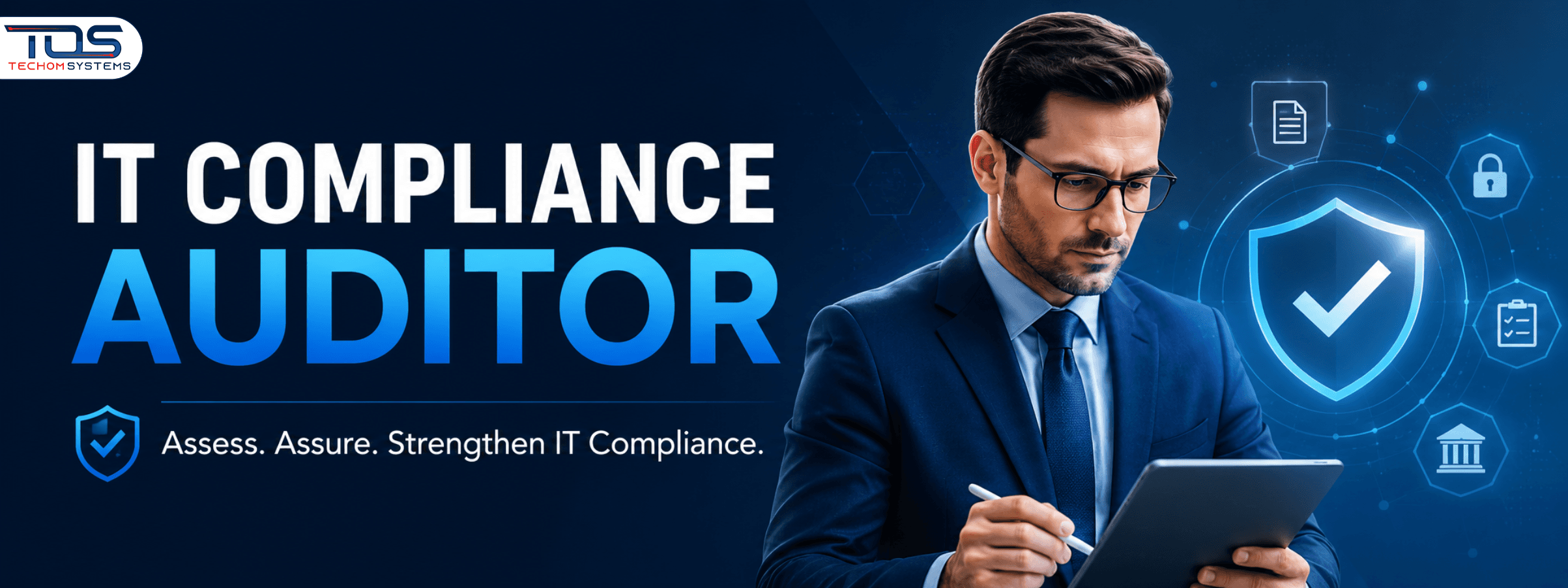
Micro Summary: An IT compliance auditor establishes structured control over regulatory alignment, risk exposure, and audit readiness. When integrated with IT security consulting, compliance becomes continuous, enforceable, and aligned with business stability and growth objectives.
Key Insights
- Undetected compliance gaps create hidden risks that only surface during audits, impacting business continuity and regulatory outcomes
- Delayed audit readiness affects revenue and deal cycles, especially in regulated environments requiring compliance validation
- Compliance and security must operate together, with IT security consulting strengthening control enforcement and reducing exposure
- Unstructured compliance leads to cost leakage through rework, duplication and repeated audit cycles
- Continuous audit readiness becomes a competitive advantage, supporting faster certifications and stronger stakeholder confidence
What is an IT Compliance Auditor?
An IT compliance auditor evaluates whether an organisation’s IT systems, processes and policies align with regulatory standards and security frameworks. They also ensure that controls are effectively implemented and consistently enforced across the environment. The role focuses on identifying compliance gaps, validating security measures, and establishing a governance structure that reduces risk exposure and supports stable operations.
By aligning compliance requirements with technical execution, the auditor helps create an audit-ready environment that strengthens accountability and improves operational clarity. This approach also enables confident business continuity by ensuring controls are consistently implemented and maintained.
Business Value and Cost Control Through Structured Compliance Auditing
IT compliance auditing is not a one-time activity, but an ongoing process that must align with regulatory requirements, security expectations, and business growth. When managed without structure, organisations face rising costs due to duplicated controls, inefficient processes and repeated audit failures often with limited visibility into actual compliance readiness.
A structured approach, driven by an IT compliance auditor, ensures better control, consistency and cost efficiency across the environment. Organisations benefit from:
- Reduced regulatory risk and penalties
- Faster certification readiness (ISO, SOC 2, GDPR, HIPAA)
- Improved enterprise deal velocity
- Stronger governance and accountability
- Consistent security posture across systems
- Elimination of duplicate efforts and unnecessary costs
With clear governance and continuous monitoring, compliance becomes predictable and measurable. This not only reduces financial leakage but also ensures resources are used efficiently, shifting compliance from a reactive expense to a controlled, value-driven function.
IT Compliance Auditor vs Reactive Compliance: The Cost Difference
Compliance approach directly impacts cost and risk. Reactive compliance leads to unpredictable expenses and disruptions, while a structured approach brings controlled processes, predictable costs, and continuous audit readiness.
|
Approach
|
Cost Impact
|
Operational Impact
|
Risk Exposure
|
|
Reactive Compliance
|
Unpredictable and increasing costs due to last-minute fixes
|
Frequent disruptions during audits and remediation cycles
|
High risk due to unidentified gaps and delayed action
|
|
Ad-hoc Internal Checks
|
Moderate costs but inefficient resource utilization
|
Inconsistent processes and lack of standardization
|
Medium risk with limited visibility
|
|
IT Compliance Auditor
|
Controlled and optimised compliance spending
|
Streamlined audit processes with minimal disruption
|
Reduced risk through continuous monitoring
|
|
Auditor + IT Security Consulting
|
Long-term cost optimisation with fewer rework cycles
|
Fully aligned compliance and security operations
|
Lowest risk with proactive control and enforcement
|
A structured compliance approach transforms compliance from a reactive cost burden into a predictable and controlled business function.
Key Capabilities of an Effective Compliance Function
A high-impact compliance function extends beyond basic evaluations, covering multi-platform environments and focusing on structured risk control, cross-technology alignment and continuous enforcement across the organisation.
1. Compliance Gap Identification: Identifies misalignments across environments—covering Microsoft 365, Azure, AWS, endpoints and identity systems ensuring issues are addressed before they escalate into audit failures.
2. Risk-Based Audit Execution: Prioritises critical business risks across cloud platforms, infrastructure and endpoint environments instead of relying on generic compliance checklists.
3. Policy & Control Validation: Verifies that policies are consistently implemented across cloud services (Azure, AWS), endpoint management tools (Intune) and identity systems, ensuring controls function as intended.
4. Integration with IT Security Consulting: Ensures compliance controls are enforced across cloud, endpoint and identity layers, with aligned configurations and continuous monitoring.
This approach ensures compliance remains consistent across modern hybrid and multi-cloud environments, not limited to a single platform.
Strengthening Compliance Through IT Security Alignment
Compliance processes alone cannot ensure protection if controls are not technically enforced across the environment. Without alignment with security practices, organisations often face gaps where policies exist, but execution remains inconsistent, increasing the risk of audit failures and security incidents.
By integrating compliance with IT security consulting, organisations establish a controlled framework where security measures actively support compliance requirements. This approach ensures continuous monitoring, consistent control enforcement, and improved visibility, creating a stable and audit-ready environment that reduces risk and operational disruption.
Get started with a structured compliance approach today and ensure your organisation stays secure, audit-ready and performance-driven.
Real-World Example - Compliance Transformation Through Structured Auditing
We have helped and continue to support Australian organisations with structured IT configuration audits, focusing on areas such as Microsoft 365 golden configuration checks, license optimisation, security posture validation and IT roadmap alignment. Many of these organisations initially faced challenges with inconsistent configurations, limited visibility into security controls,, and gaps in compliance readiness.
By implementing a structured auditing approach, TECHOM Systems standardised configurations across Microsoft 365 environments, optimised licensing and strengthened security controls through aligned IT security consulting. This also enabled organisations to establish a clear IT roadmap aligned with business and compliance goals. As a result, these organisations improved their overall compliance posture, accelerated audit readiness, and achieved measurable cyber uplift.
When Should You Engage an IT Compliance Auditor?
An organisation should engage an IT compliance auditor during growth, audit preparation, regulatory expansion, or when compliance gaps begin affecting risk and operations.
|
Business Scenario
|
Compliance Requirement
|
Impact
|
|
Rapid scaling
|
Structured compliance framework
|
Controlled growth
|
|
Entering regulated markets
|
Certification readiness
|
Faster market access
|
|
Audit failures
|
Remediation and restructuring
|
Risk reduction
|
|
Security incidents
|
Compliance validation
|
Improved resilience
|
|
Digital transformation
|
Governance alignment
|
Stable operations
|
Indicators Your Organisation Requires Structured Compliance Auditing
Uncontrolled compliance challenges often indicate deeper structural gaps in governance and risk management. Organisations should take immediate action when they experience:
- Rising compliance costs without clear visibility or justification
- Frequent audit findings, failures, or delays
- Lack of alignment between IT operations and compliance requirements
- Security tools in place but without structured governance or enforcement
- Ongoing difficulty in achieving or maintaining certifications
These are not isolated operational issues—they signal underlying strategic risks that require structured compliance control.
Why Organisations Engage External Compliance Audit Experts
Organisations engage external compliance audit experts to ensure objective assessments, faster execution and structured methodologies. They also leverage cross-industry expertise and integrated IT consulting to maintain consistent, scalable and audit-ready compliance environments.
- Independent and unbiased assessment ensuring that compliance evaluations remain objective, free from internal influence and aligned with regulatory expectations
- Cross-framework expertise enabling consistent alignment across multiple standards such as ISO, SOC 2, GDPR and other regulatory requirements without creating operational overlaps
- Faster audit execution through structured processes, predefined frameworks and experienced audit handling, reducing delays and minimising disruption to business operations
- Proven compliance methodologies built on repeatable, industry-tested practices that improve audit accuracy, reduce rework and strengthen long-term compliance stability
- Integration with IT consulting services ensures that compliance controls are not only defined but technically implemented, continuously monitored and aligned with evolving security requirements.
Frequently Asked Questions
1. What is the ROI of engaging an IT compliance auditor?
The ROI comes from reduced audit failures, lower remediation costs,, and faster certification timelines. Organisations also avoid regulatory penalties and improve deal conversion rates, making compliance a cost-controlled and value-generating function.
2. How does compliance auditing impact business performance?
Compliance auditing enhances operational efficiency by identifying gaps early, reducing rework, and avoiding last-minute audit disruptions. It also improves credibility during enterprise deals by demonstrating a strong and reliable compliance framework.
3. When should an organisation engage a compliance auditor?
Organisations should engage a compliance auditor when preparing for certifications, scaling operations, entering regulated markets, or addressing recurring audit findings. Early engagement ensures smoother audits and fewer compliance challenges.
4. How does IT security consulting support compliance auditing?
IT security consulting ensures that compliance requirements are not just documented but technically implemented and continuously monitored. This alignment helps maintain consistent control enforcement and reduces the risk of compliance failures.
5. Can compliance auditing help reduce long-term costs?
Yes, a structured compliance auditing approach minimises penalties, reduces redundant processes, and prevents repeated audit failures. Over time, this leads to more predictable spending and improved operational efficiency.
Related Blogs
Why Organisations Trust TECHOM Systems for Compliance Success?
TECHOM Systems delivers structured, outcome-driven compliance solutions aligned with business objectives. With increasing regulatory complexity and evolving security expectations, a strong focus on execution and control is essential to maintain efficiency and reduce risk exposure. Organisations benefit from IT compliance auditor expertise that ensures consistent governance, cost control and audit-ready environments supported by:
- Tailored compliance frameworks aligned with operational and regulatory requirements
- Proven audit methodologies ensuring faster, accurate audit readiness
- Integrated IT security consulting for enforced and monitored controls
- Reduced compliance risk and operational complexity
- Scalable approach supporting business growth and evolving compliance needs
TECHOM Systems ensures compliance is not just achieved, but consistently maintained with clarity, control, and long-term efficiency.
Conclusion
Compliance is no longer optional. Compliance is a core requirement for operational stability and growth. An IT compliance auditor brings structure, control and continuous audit readiness while reducing risk and eliminating inefficiencies.
By aligning compliance with IT security consulting, organisations create a predictable, scalable framework where compliance is actively managed and not reactively fixed.
Speak with our experts today and build a compliance framework that delivers control, clarity and long-term business stability.