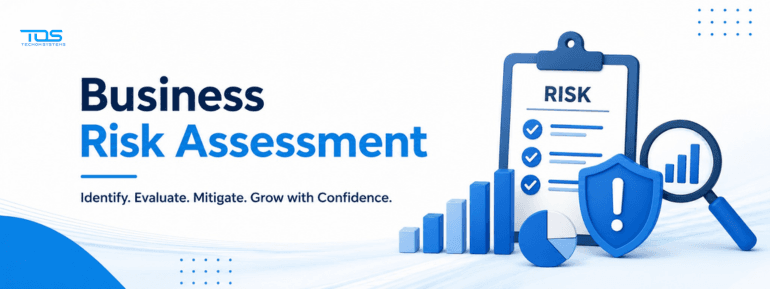
A Business Risk Assessment gives Australian organisations a clear, evidence-based view of risk. It covers operational, cyber, and compliance exposure before critical decisions are made. Boards, CEOs, CIOs, and risk managers rely on structured Risk Assessment engagements. These engagements validate governance frameworks, satisfy regulators, and protect stakeholder confidence. Choosing the right consulting partner determines whether that assessment delivers measurable outcomes or sits unused on a shelf.
TECHOM Systems is an ISO 27001 certified Australian consultancy. We deliver Business Risk Assessment and IT Audit Consulting Services for commercial decision-makers across regulated industries. This article compares what separates a genuinely useful Business Risk Evaluation from a generic checklist. It also sets out what to expect when engaging a specialist provider.
Key Takeaways
- A Business Risk Evaluation quantifies operational, cyber, and compliance exposure so leaders can prioritise investment with confidence.
- Effective assessments combine IT Risk Assessment, Cyber Risk Assessment, and Governance Risk and Compliance (GRC) methodology, not generic surveys.
- Frameworks such as the NIST Cybersecurity Framework, ISO 27001, and the Essential Eight Assessment give assessments defensible, auditable structure.
- Skipping a formal risk assessment increases financial exposure, audit failure risk, and regulatory penalties.
- TECHOM Systems delivers Business Risk Assessment services backed by deep IT Audit Consulting Services experience.
What Is a Business Risk Assessment and Why Decision-Makers Need One
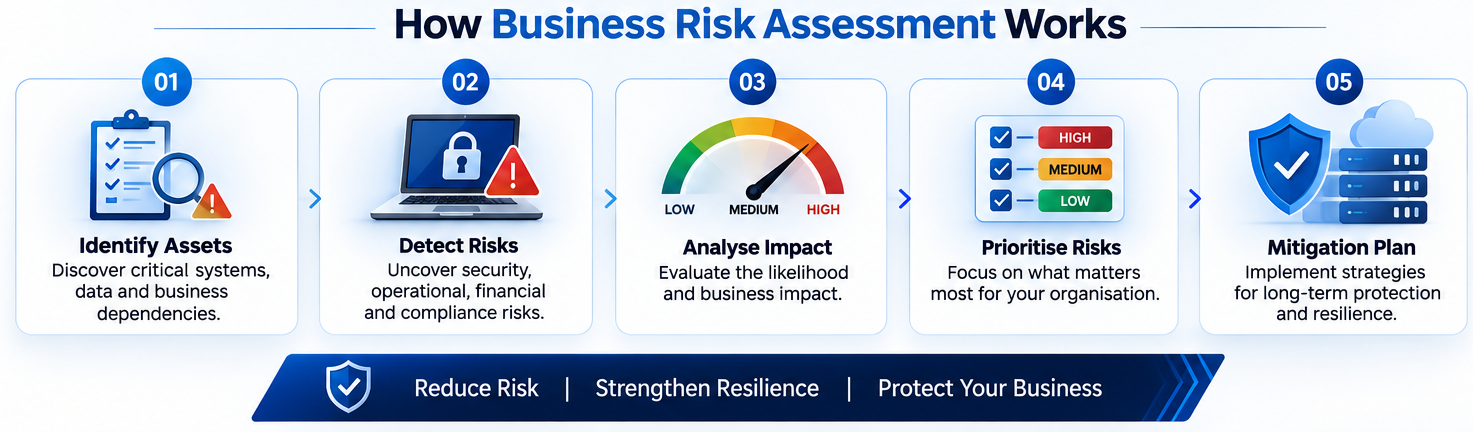
A Risk Assessment for business is a structured evaluation of operational, technology, cyber, and compliance risks. These risks could disrupt a business or cause financial and reputational loss. It identifies critical assets, maps threats, and prioritises remediation by business impact.
For commercial leaders, this is not an academic exercise. A well-executed Enterprise Risk Assessment informs budget allocation, insurance negotiations, board reporting, and vendor contracts. It replaces guesswork with a documented, defensible risk position.
TECHOM Systems brings more than 15 years of Australian consulting experience to every engagement. Our expertise spans Risk Management Consulting, Information Security Assessment, and IT Governance.
Business Risk Assessment vs IT Audit - What's the Difference
A Business Risk Assessment identifies and prioritises risk across the whole organisation. An IT Audit tests whether specific controls, policies, and systems are operating as designed. Most enterprise clients need both, sequenced correctly.
|
Aspect
|
Business Risk Assessment
|
IT Audit
|
|
Primary focus
|
Enterprise-wide operational, cyber, and compliance exposure
|
Verification of specific IT controls and policies
|
|
Methodology
|
Risk identification, scoring, and prioritisation
|
Control testing against a defined standard
|
|
Typical output
|
Risk register and mitigation roadmap
|
Audit findings report and compliance gap list
|
|
Best suited for
|
Strategic planning, insurance, board reporting
|
Regulatory compliance, certification readiness
|
TECHOM Systems delivers both through our IT Audit Consulting Services. This gives clients a single, coordinated view of risk and control performance.
What a Professional Risk Assessment Covers
A commercially useful Business Risk Assessment goes beyond a technical scan. It should combine the following disciplines into one prioritised risk view:
- Asset and data classification, including sensitive and regulated data stores
- Cyber Risk Assessment and Vulnerability Assessment across networks, endpoints, and cloud
- Third-Party Risk Assessment covering vendors, suppliers, and managed service providers
- Compliance mapping against ISO 27001 Consulting standards, the Essential Eight Assessment, and the NIST Cybersecurity Framework
- Business Continuity Planning and Disaster Recovery Assessment
- Privacy Risk Assessment aligned to the Australian Privacy Principles
- A weighted Risk Mitigation roadmap with clear ownership and timeframes
The TECHOM Systems Business Risk Assessment Framework
Every engagement follows a consistent, auditable methodology so findings hold up under board and regulatory scrutiny-
- Discovery and scoping — confirm business objectives, regulatory obligations, and critical assets.
- Risk identification and threat modelling — assess technology, process, and third-party exposure.
- Governance and compliance mapping — benchmark against ISO 27001, Essential Eight, and NIST frameworks.
- Risk mitigation roadmap — prioritise remediation by financial and operational impact.
- Ongoing monitoring and review — reassess as systems, vendors, and regulations change.
Signs Your Business Needs a Professional Risk Assessment Now
Certain triggers signal that an assessment is overdue rather than optional. Recognise them early to avoid reactive, higher-cost remediation later.
- A recent security incident, near-miss, or unexplained system outage
- An upcoming compliance deadline, ISO 27001 audit, or government tender requirement
- No documented governance framework, risk register, or business continuity plan
- Unclear visibility over third-party and vendor risk exposure
- Board or executive requests for a formal, defensible risk position
- Cyber insurance renewal requiring evidence of a current Security Risk Assessment
Business Impact of Skipping a Business Risk Assessment
The cost of inaction compounds over time. The table below summarises common consequences reported by Australian organisations that delay a formal assessment.
|
Risk area
|
Consequence of inaction
|
Business impact
|
|
Cyber exposure
|
Unpatched vulnerabilities remain undetected
|
Higher breach likelihood and recovery cost
|
|
Compliance
|
Gaps against ISO 27001 or Essential Eight go unaddressed
|
Failed audits, lost contracts, penalties
|
|
Governance
|
No documented risk register or ownership
|
Slower, less informed board decisions
|
|
Continuity
|
Untested disaster recovery and business continuity plans
|
Extended downtime after an incident
|
|
Insurance
|
Insufficient evidence for cyber insurance underwriting
|
Higher premiums or denied claims
|
Industry-Specific Business Risk Assessment Use Cases
Financial Services and Banking
Financial institutions face strict regulatory scrutiny. A Business Risk Assessment supports APRA-aligned governance, strengthens Cyber Security Assessment posture, and protects client financial data.
Healthcare Providers
Healthcare organisations manage highly sensitive patient data. Assessments prioritise Information Security Assessment controls, third-party risk, and continuity planning to protect patient care and privacy.
Government and Education
Public sector and education bodies must demonstrate compliance with government security frameworks. A structured assessment supports audit readiness, Essential Eight Assessment maturity, and public accountability.
Manufacturing and Enterprise
Manufacturers rely on operational technology and supply chains. A Technology Risk Assessment identifies operational risk, protects intellectual property, and reduces costly production downtime.
Why Australian Businesses Choose TECHOM Systems for Business Risk Assessment Services
TECHOM Systems is an ISO 27001 certified Australian consultancy with more than 15 years of experience. We specialise in Cyber Security Assessment, Microsoft Security Assessment, Cloud Security Assessment, and Governance Risk and Compliance (GRC) consulting. Our team combines Risk Advisory Services with hands-on Managed IT Services delivery, so recommendations are practical, not theoretical.
We work across financial services, healthcare, education, government, and manufacturing. Every Business Risk Assessment is tailored to sector-specific compliance obligations.
How to Choose the Right Business Risk Assessment Partner
Use this decision framework to evaluate consulting partners before you commit to a Business Risk Assessment engagement:
- Verified certifications, including ISO 27001 Consulting accreditation
- Demonstrated Australian regulatory and industry experience
- Clear, board-ready reporting rather than raw technical output
- A documented Risk Mitigation roadmap with realistic timeframes
- Ongoing monitoring and review, not a one-off engagement
- Transparent methodology aligned to recognised frameworks such as NIST and the Essential Eight
Frequently Asked Questions
#1. What does a Business Risk Assessment include?
It covers asset classification, threat and vulnerability identification, compliance mapping, third-party risk, and a prioritised mitigation roadmap.
#2. How long does a Business Risk Assessment take?
Most engagements take two to six weeks, depending on organisation size, number of systems, and the regulatory frameworks involved.
#3. Is a Business Risk Assessment mandatory for compliance?
Many frameworks, including ISO 27001, expect documented evidence of a current risk assessment. Government tenders often require it too.
#4. How often should a Business Risk Assessment be conducted?
Annually at minimum, with additional reviews after major system changes, incidents, or new regulatory obligations.
#5. What's the difference between a Cyber Risk Assessment and a Business Risk Assessment?
A Cyber Risk Assessment focuses on technology threats. A Business Risk Assessment is broader, covering operational, governance, and compliance risk alongside cyber exposure.
Get Started with a Business Risk Assessment
A well-executed Business Risk Assessment gives Australian leaders the clarity to reduce operational risk. It also helps meet compliance obligations and strengthen stakeholder confidence. TECHOM Systems combines ISO 27001 certified governance expertise with practical IT Audit Consulting Services experience. Together, these deliver assessments that drive real business outcomes, not just a report.
If your organisation needs a defensible, commercially focused Business Risk Assessment, now is the time to act. Don not wait for the next audit, incident, or compliance deadline to force the decision.
Ready to strengthen your governance and cyber resilience