Micro Summary: Azure Communication Services with Direct Routing gives organisations enterprise-grade telephony through the cloud, eliminating on-premise PBX hardware without disrupting existing carrier infrastructure or phone numbers. The Dynamics 365 Voice Channel embeds a complete contact centre inside your CRM, so agents manage inbound and outbound calls, customer records, and AI-powered tools from a single unified Microsoft interface. TECHOM Systems deploys Azure Communication Services Direct Routing for organisations across Australia, UK, US, and Europe. We deliver a fully managed, cloud-native telephony foundation that connects seamlessly with Dynamics 365.
Key Insights
Unified voice, AI, and CRM intelligence in one Microsoft-native platform.
- Azure Communication Services eliminates on-premise PBX hardware and reduces infrastructure costs significantly over three years.
- Direct Routing retains existing phone numbers and live carrier contracts throughout migration, no service disruption.
- The Dynamics 365 Voice Channel delivers automatic screen pops, real-time transcription, and AI sentiment analysis on every call.
- Microsoft Copilot integration reduces average handle time by up to 40% and accelerates onboarding for new agents.
- TECHOM Systems manages every phase of deployment, from infrastructure configuration through to agent training and post-go-live optimisation.
- Organisations typically achieve positive ROI within three to six months of deployment.
- Azure data residency options support compliance requirements across Australia, EU, UK, and US.
1. What Is Azure Communication Services with Direct Routing?
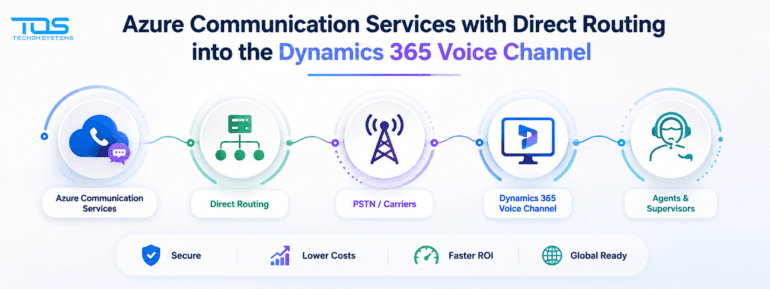
Azure Communication Services (ACS) is Microsoft’s cloud-native platform for voice, video, chat, and SMS. It delivers enterprise telephony as a fully managed service, removing the need for physical hardware, on-premise servers, or PBX licence management entirely.
Direct Routing is the connectivity layer that bridges Azure Communication Services to the Public Switched Telephone Network. A certified Session Border Controller sits between your existing carrier and Microsoft Azure, handling all call signalling over an encrypted connection. The architecture is built to handle enterprise call volumes with the geographic redundancy and reliability that Microsoft’s global infrastructure provides.
What this architecture enables is a clean path to cloud-native telephony without walking away from existing carrier relationships, geographic numbers, or 1300 and 1800 helpline numbers that may have been in service for years. From a customer perspective, nothing changes. From a business perspective, everything does.
|
Key Fact: Azure Communication Services is built on the same global infrastructure that powers Microsoft Teams, used by over 320 million people worldwide. This means organisations inherit enterprise scale, global reach, and carrier-grade reliability without the complexity of managing it themselves. |
2. The Dynamics 365 Voice Channel: Contact Centre Inside Your CRM
The Dynamics 365 Voice Channel is a native contact centre capability built directly inside Microsoft Dynamics 365 Customer Service. This matters more than it might initially seem. When telephony is a third-party integration, you are always managing the gap between two vendors, two update cycles, and two sets of support escalations. With the Voice Channel, Microsoft owns the entire stack, which means features are designed to work together from the outset and there is no integration debt to carry forward.
When Azure Communication Services with Direct Routing powers the Voice Channel, agents handle inbound and outbound calls entirely within their Dynamics 365 environment. An inbound call arrives and the customer’s record is already on screen before the agent says a word. There is no switching between applications and no time spent on post-call note-taking, because the platform captures what matters automatically.
What the Voice Channel Delivers for Agents and Supervisors
- Embedded softphone inside Dynamics 365, no separate telephony client required
- Automatic screen pop with full customer history, open cases, and recent interactions on every inbound call
- Outbound calling placed directly from contact records and case pages
- IVR flows and intelligent call routing built and managed inside Dynamics 365
- Real-time transcription of every call using Azure AI services
- Post-call sentiment analysis and structured conversation summaries
- Supervisor dashboards with live call monitoring, barge-in, and whisper-coaching
Microsoft Copilot suggestions for knowledge articles and next-best actions during live calls
|
💡 Did You Know? Voice channels are evolving into AI-powered, data-driven business intelligence assets
|
3. Business Benefits That Drive Commercial Value
Eliminate Infrastructure Costs
Most organisations running legacy telephony underestimate the ongoing cost of keeping it operational. Beyond the initial hardware investment, PBX servers, ISDN lines, maintenance contracts, and the specialist engineers required to manage them represent a recurring drain on IT budgets year after year, rarely delivering any capability improvements in return for that spend.
Moving to Azure Communication Services with Direct Routing removes most of that overhead from the equation. Microsoft takes responsibility for the cloud infrastructure, while TECHOM Systems handles the connectivity architecture, carrier coordination, and ongoing platform support.
Retain Existing Numbers and Carrier Contracts
One concern that comes up repeatedly in migration conversations is number retention. Direct Routing is specifically designed to address this. Geographic numbers, 1300 and 1800 numbers, DDIs, and existing carrier agreements all carry across during migration. Customers never notice the change because nothing visible to them changes.
Support Hybrid and Remote Teams Globally
The Dynamics 365 Voice Channel operates entirely in a modern web browser. Agents work from any location with an internet connection. Supervisors monitor live calls, barge in, and whisper-coach in real time, regardless of where those agents are based.
This is a significant operational advantage for organisations with distributed teams across multiple time zones, including businesses with contact centres in Australia, the UK, the US, or offshore locations.
The Dynamics 365 Voice Channel runs entirely in a web browser. There is no client software to install or maintain, which means agents can work from any location with a reliable internet connection. Supervisors retain full oversight: live call monitoring, barge-in capability, and whisper-coaching all work in real time regardless of where agents are physically based.
For organisations running distributed teams across multiple time zones, including those with contact centre operations spanning Australia and offshore locations, this browser-based model removes the geographic constraints that have historically complicated telephony deployments.
Unify Communication and CRM Data
Every call handled through the Voice Channel is automatically logged, transcribed, and attached to the right customer record. Sales teams can review previous conversations before a follow-up call. Support teams see a complete case history from the moment an inbound call connects. The separation between telephony data and CRM data, which has historically forced agents into manual workarounds, simply disappears. What remains is a searchable, structured record of every interaction, built without any extra effort from agents.
|
Performance Insight: Organisations that unify telephony with Dynamics 365 typically report a 30–40% reduction in average call handle time, driven by instant customer context and AI-assisted responses on every interaction. |
4. AI and Call Intelligence Capabilities
One of the more significant differences between this platform and conventional contact centre telephony is what happens with every conversation. Azure Communication Services and Dynamics 365 are deeply integrated with Microsoft’s AI layer, and these capabilities come included within the Voice Channel. There is nothing separate to procure or configure: from the first call, every interaction is transcribed, analysed, and summarised automatically.Real-Time Transcription and Searchable Call Records
Every call is transcribed as it happens. Agents and supervisors can see the live text on-screen during the conversation, which is particularly useful for complex or sensitive interactions where accuracy matters. Once the call ends, the transcript is stored against the customer record and becomes fully searchable by keyword, phrase, or date range. For compliance teams, this changes the process significantly: specific conversation content can be queried in seconds rather than requiring someone to work through recordings manually.
Azure AI monitors the tone of both the agent and the customer throughout each call. Sentiment indicators update in real time on the supervisor dashboard, so a shift toward frustration or dissatisfaction is visible immediately rather than discovered after the fact in a complaint. Supervisors can intervene before a conversation deteriorates, which in practice reduces formal complaints and protects relationships that would otherwise be hard to recover. It also gives management a genuine, data-driven view of call quality across the team rather than relying on periodic spot-checks.
Microsoft Copilot for Agent Assistance
Microsoft Copilot is embedded directly into the Voice Channel interface. As a call progresses, Copilot surfaces relevant knowledge articles, similar resolved cases, and product detail in real time, without the agent needing to leave the conversation to go searching. New agents benefit immediately, reaching productive performance significantly faster than on traditional platforms. Experienced agents find they can handle a wider range of complex queries with greater confidence. Across a team of any size, the cumulative effect is a measurable improvement in consistency and a reduction in the time it takes agents to reach reliable performance.
Post-Call AI Summaries and Action Capture
When the call ends, AI generates a structured summary of what was discussed, what was agreed, and what follow-up is needed. This is written to the customer record automatically. Agents move straight to the next interaction without pausing to type notes, and managers receive consistent, structured reporting across every agent and every call without any manual aggregation. Over time, this builds a rich and reliable record of customer communications that would be almost impossible to maintain at the same quality through manual processes.
5. Global Use Cases by Industry
Financial Services and Insurance
Financial services organisations use Azure Communication Services Direct Routing for compliance call recording, real-time transcription for audit trails, and intelligent routing to specialist advisers. Copilot assists agents with product information during live calls, while IVR menus reduce queue times and improve the customer experience from first contact.
Healthcare and Allied Health
Healthcare providers manage appointment bookings and clinical queries with patient records surfacing automatically during inbound calls. Role-based access controls restrict sensitive data to authorised staff. Call recording retention policies are configured to meet clinical governance and regulatory requirements across different jurisdictions.
Professional Services
Law firms, accounting practices, and consulting organisations log calls against client matter records, trigger time entries from call outcome data, and give every team member complete client interaction history before callbacks. Call recordings stored in Dynamics 365 become a permanent part of the client file.
Retail, E-Commerce, and Government
Retailers resolve delivery queries faster when order history appears automatically on-screen. Government agencies retain 1300 and 1800 helpline numbers via Direct Routing while meeting data sovereignty requirements through Azure's regional data centres. In every sector, the common outcome is fewer systems, faster resolution, and richer customer data.